I study the bacteria Flavobacterium columnare. It is a fresh water bacteria found all over the world. It is an opportunistic fish pathogen and is the cause of Columnaris Disease (CD). It infects many commercially important fish species. Outbreaks in aquaculture facilities are common. Costs associated with CD are high and represent a major barrier to the development of commercially viable aquaculture enterprises.
Outbreaks are brought on by stress and can occur suddenly. Mortality rates can reach 100%. The most virulent strains F. columnare kill susceptible fish within 24 to 48 hours, leaving little time for treatment.
CD is common in tropical aquaria where it is called by various names including, fin rot, tail rot and cotton mouth. These are frequently discussed on websites for aquaria hobbyist. The bacteria responsible is often identified as Flexibacter columnaris, an obsolete genus and species name replaced in the mid 1990. The characteristic fuzzy white growth the bacteria cause, often results in hobbyists mistaking it for a fungal infection.
CD also effects wild fish stocks. Outbreaks usually occur in the spring as the water warms. These outbreaks can be quite dramatic with hundreds or even thousands of moribund fish washing ashore covered with lesions. In less populous areas, these outbreaks go unnoticed. When they occur in lakes in populated areas, the fish die-offs make the news.
No one likes to see (or smell) tons of dead fish washing up on their shore.
Monday, May 17, 2010

Thursday, May 13, 2010
China in Africa
Howard French has an article in the Atlantic describing the significant investments China is making to build infrastructure across Africa. Chinese investment in Africa currently exceeds $100 billion annually. China’s approach to development differs from the west. The west provides support primarily in the form of grants and heavily subsidized loans. China’s focus is on trade and investment in commercially viable enterprises.
In this model, China provides infrastructure development to Africa. In return, China gets access to the continents vast natural resources including iron, cobalt, copper and other minerals needed to feed its enormous manufacturing based economy.
The key question is if this openly capitalistic, investment based approach can offer sustainable development for Africa. Or, is China gaining access to the continents mineral resource for short term unsustained infrastructure improvements.
History shows that this concern is well founded. French illustrates this by describing a trip on the poorly maintained Tazara train line in Tanzania. The Tazara train line was built by the Chinese in the early 1970’s. It is as an example how mismanagement and corruption led to this big past investment failing to realize its potential.
Simply building infrastructure is not enough. In order to take full advantage of physical infrastructure improvements, investments to train the human capital needed to maintain the infrastructure is also needed. It is not necessarily the obligation of foreign investors such as China to do this, but if the goal is to help the continent develop, it is essential.
It all boils down to educating to empower the local population.
In this model, China provides infrastructure development to Africa. In return, China gets access to the continents vast natural resources including iron, cobalt, copper and other minerals needed to feed its enormous manufacturing based economy.
The key question is if this openly capitalistic, investment based approach can offer sustainable development for Africa. Or, is China gaining access to the continents mineral resource for short term unsustained infrastructure improvements.
History shows that this concern is well founded. French illustrates this by describing a trip on the poorly maintained Tazara train line in Tanzania. The Tazara train line was built by the Chinese in the early 1970’s. It is as an example how mismanagement and corruption led to this big past investment failing to realize its potential.
Simply building infrastructure is not enough. In order to take full advantage of physical infrastructure improvements, investments to train the human capital needed to maintain the infrastructure is also needed. It is not necessarily the obligation of foreign investors such as China to do this, but if the goal is to help the continent develop, it is essential.
It all boils down to educating to empower the local population.
Monday, May 10, 2010
Nature's contribution to modern science
The polymerase chain reaction or PCR is central to much of the molecular biology research performed today. The technique was used for the human genome project, is used as the definitive test to identify many pathogens including H1N1 and is the basis for our understanding of the tree of life. Hundreds of thousands, if not millions of PCR’s are performed every day in labs all over the world. The enzyme used for PCR is called Taq Polymerase1. It is at the heart of the PCR reaction and it was not engineered by man. Rather, it evolved billions of years ago. It is a beautiful example of natures power to innovate.
Polymerases are a class of enzyme that catalyze the synthesis of a chain, or polymer, from component parts. Taq polymerase is a DNA polymerase, catalyzing the syntheses of DNA from nucleic acids. All living things have to have at least one DNA polymerase in order to synthesize the DNA required for growth and reproduction.
The exponential amplification characteristic of PCR stems from ability to repeat the reaction steps over an over again by cycling the reaction through a series of temperatures. These temperature steps include one at near boiling. This high temperature separates the double strands of DNA allowing each strand to be used as a template to synthesis more DNA.
Most enzymes (including most DNA polymerases) are not heat stable. They denature when heated and lose their activity, even after they are cooled back down. Taq polymerase isolated from the thermophilic bacteria Thermus aquaticus retains it activity after being heated to near boiling (95 °C). It is not active at 95 °C, but renatures and regains its activity upon being cooled. The ability of Taq polymerase it to remain active after repeatedly being heated allows the cycling of the PCR to create billions of copies of a target sequence from a single template using reagents added at the begining of the reaction.
1This was the first theromostable polymerase to be widely used. In the more than 25 years since its introduction, other heat stable polymerases have been introduced.
*last edited 11 May 2010 - minor edits and links added
Polymerases are a class of enzyme that catalyze the synthesis of a chain, or polymer, from component parts. Taq polymerase is a DNA polymerase, catalyzing the syntheses of DNA from nucleic acids. All living things have to have at least one DNA polymerase in order to synthesize the DNA required for growth and reproduction.
The exponential amplification characteristic of PCR stems from ability to repeat the reaction steps over an over again by cycling the reaction through a series of temperatures. These temperature steps include one at near boiling. This high temperature separates the double strands of DNA allowing each strand to be used as a template to synthesis more DNA.
Most enzymes (including most DNA polymerases) are not heat stable. They denature when heated and lose their activity, even after they are cooled back down. Taq polymerase isolated from the thermophilic bacteria Thermus aquaticus retains it activity after being heated to near boiling (95 °C). It is not active at 95 °C, but renatures and regains its activity upon being cooled. The ability of Taq polymerase it to remain active after repeatedly being heated allows the cycling of the PCR to create billions of copies of a target sequence from a single template using reagents added at the begining of the reaction.
1This was the first theromostable polymerase to be widely used. In the more than 25 years since its introduction, other heat stable polymerases have been introduced.
*last edited 11 May 2010 - minor edits and links added
Monday, May 03, 2010
clearly stated target outcomes are needed to form good policy
In my current job, I have participated in the planning and writing of several multi-million dollar grants. On more than one occasion I have been struck by how meager the planning process was. Programs are developed with little in the way of clear objectives, evaluation metrics or paths to sustainability. Of course, this problem is not unusual as Jeffery D. Sachs explains in the May issue of Scientific American:
During 14 months of debate over health care, the administration did not put forward a clear, analytical policy white paper on the aims, methods and expected results of the proposed reforms. Only the Congressional Budget Office’s budget scoring of legislative proposals was even partly systematic; no comparable independent analysis exists on other substantive issues. The actual health consequences of the legislation were never reviewed or debated coherently.
Thursday, April 22, 2010

Wednesday, April 21, 2010
Green glowing frogs detect pollution
Just came across this article from last December about engineering tadpoles to express green fluorescent protein when exposed to pollutants. A strength this approach has over more traditional techniques is that the tadpoles only respond to bioavailable forms of target toxins.
Since this is fluorescence not luminescence, the detection would require at minimum a special light source and a filter. My first thought when seeing this was to wonder how they detect the fluorescence. According to the researchers this turned out to be “nontrivial.”
Product literature available at the website of the company the researchers founded, WatchFrog, says that the method can be used to detect hormonal disruptors and heavy metals.
Since this is fluorescence not luminescence, the detection would require at minimum a special light source and a filter. My first thought when seeing this was to wonder how they detect the fluorescence. According to the researchers this turned out to be “nontrivial.”
"Tadpoles aren't just going to sit still while you measure them. They're usually off and running."
Product literature available at the website of the company the researchers founded, WatchFrog, says that the method can be used to detect hormonal disruptors and heavy metals.
Tuesday, April 20, 2010
It is a microbial world!
Researchers scouring the world's oceans have been forced to drastically revise estimates for the number of microbial species residing there after a census indicated up to one hundred times the expected diversity may be present.Qiu 2010. Nature Online
Thursday, December 27, 2007
Open access mandated by law
This is excellent news! The big funding bill Bush just signed into law includes the provision that all NIH funded research be made open access within 12 months of publication.
Read more here.
Read more here.
Thursday, August 09, 2007
PCR
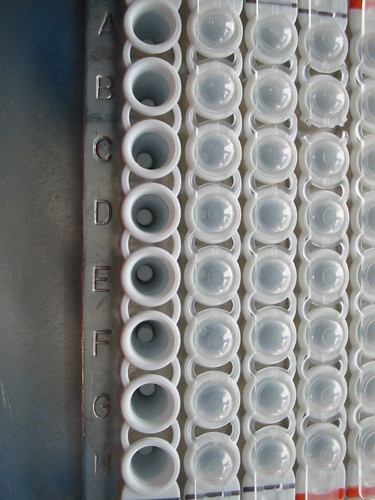 It is an exciting time to be following progress in the field of microbial ecology. While the awareness of the abundance of microscopic organisms is not new, the development of new methods to observe the microscopic world continue to deepen our understanding. Some of these methods have been described briefly on this blog. See the entry on 454 sequencing for example.
One of the most important techniques for modern microbial ecology and biology as a whole is the polymerase chain reaction or PCR. I suspect most of my modest readership is familiar with the technique, if any of you are not, it is something that you ought to take the time to learn about. A google search of the term PCR reveals a large number of pages devoted to explaining the technique. Many people have also developed diagrams and animations to aid in the understanding. The problem is, most of the good animations do not stand on their own. To make use of them, some background knowledge is needed.
The best animation I have seen on the web is this one. Go ahead and look at both the amplification animation and the interactive graph showing the number of copies of the target molecule present after each cycle.
Here are some things to keep in mind:
- DNA is a double stranded molecule and the two strands are held together by hydrogen bonds. Each individual bond is weak, the strength of the bonding between the two strands arises from the sheer number of individual bonds present. Key point for PCR: The bonding that holds the double strand together is easily disrupted by heat. Thus the 95 deg C steps
- DNA is made up of 4 nucleotides: adenine, thymine, cytosine and guanine attached to each other along a sugar-phosphate backbone. The hydrogen bonding between the two strands of the double stranded molecule are between these nucleotides. The pairing of the nucleotides is specific. Adenine always binds with thymine and guanine with cytosine. Key point for PCR: knowing the sequence of one of the strands of the double stranded DNA makes it possible to deduce the sequence of the opposite strand.
- DNA polymerase is the enzyme required for PCR. The enzyme is capable of synthesizing double stranded DNA from single stranded DNA using the single strand as a template. The activity of this enzyme is specific in several ways. Most importantly for PCR:
- The nucleotide bases strung along the sugar-phosphate backbone of each DNA strand has directionality.a and each of the two strands in the double stranded molecule are oriented in the opposite direction. DNA polymerase can elongate in only one direction. Key point for PCR: the DNA polymerase must elongate each of the two strands from opposite ends.b
- DNA polymerase can not elongate single stranded DNA. A short fragment of double stranded DNA is needed. Key point for PCR: Small lengths of double stranded DNA need to be created flanking the region targeted for amplification (these are the primers).
- The exponential nature of PCR amplification depends on multiple cycles of amplification involving both strands of the double stranded molecule. Key point for PCR: Two primers are needed.
- DNA polymerase - the enzyme.
- 2 primers - Small fragments of single stranded DNA. These are used to produce short regions of double stranded DNA flanking the sequence targeted for amplification.
- Free nucleotides - These must be in the form of nucleotide triphosphates. In this form, they provide the source of the bases needed to build new strands of DNA and the energy required to drive the reaction.
- Template - some DNA containing the region that is to be targeted.
There is much more to say about PCR but this post is already long enough so go enjoy the animation.
aFor a better understanding of the structure of the DNA molecule itself see DNA is a polynucleotide by Larry Moran at Sandwalk.
bSee here and here for an interesting exception to this rule on directionality.
Image from Flickr
Wednesday, August 08, 2007
Bacteria and the cost of oil
 Oil is considered sour if it contains reduced sulfur compounds (sulfides) at concentrations of 1% or greater. High concentrations of sulfides in oil are problematic for a variety of reasons including:
- Hydrogen sulfide is extremely corrosive and can cause damage to the pipes used to transport oil.
- When complexed with other metals such as iron, the sulfides can form precipitates that restrict the flow of oil in the pipes.
- Sulfides are toxic and cause environmental and health problems in areas where sour oil is produced, processed or burned.
Souring of oil is exacerbated by the common practice of pumping water into older oil fields to increase the pressure in the fields as a way to increase oil recovery. Depending on the source of the water used, this practice can introduce large quantities of sulfate (SO4) into the oil/water mixture. Any oxygen present in the water when it is first pumped underground is rapidly consumed by microbial activity. Once the oxygen is gone, anaerobic microbes can contiune to extract energy from the organic mater present by using compounds other than oxygen as terminal electron acceptors. Sulfate reducing bacteria or SRBs are anaerobes that are able to use sulfate as an electron acceptor. The process results in the production of oxidized carbon compounds and reduced sulfur (sulfides). Biocides are often added to the water to inhibit microbial activity but this process is not efficient requiring enormous amounts of toxic compounds to be added to the water to have a lasting impact.
Thus, microbial activity in oil fields contributes the the cost of oil production. Microbial sulfide production is not limited to oil reservoirs. SRBs are also responsible for the 'rotten egg' smell associated with other anaerobic environments such as swamps and septic systems.
Subscribe to:
Posts (Atom)


